
Hosting iftar at home is one of the most meaningful ways to gather people in Ramadan — but it can also be one of the most demanding. You’re not just making dinner. You’re managing a fixed serving time at sunset, hosting while fasting, and trying to create an evening that feels warm, generous, and calm.
That’s why the best iftar hosting tips are not only about recipes or decor. They’re about kitchen strategy.
This guide is built for real homes and real constraints: small kitchens, limited stove space, busy schedules, mixed guest preferences, and the very real fatigue that comes with fasting. If you want stress-free iftar hosting, this is your practical blueprint.
You’ll learn how to:
- plan a home iftar without overwhelm,
- build a generous but manageable menu,
- organize your kitchen for smooth prep and serving flow,
- time everything around Maghrib/iftar,
- and host a beautiful, welcoming evening without overcomplicating it.
What Makes Hosting Iftar at Home Different From a Regular Dinner Party
The unique pressure of hosting while fasting
A regular dinner party gives you room to improvise. Iftar usually doesn’t.
When you’re hosting iftar at home, you may be:
- cooking while fasting,
- lower on energy by late afternoon,
- unable to taste as you go,
- and trying to have everything ready at a specific moment.
That combination creates a different kind of pressure. It’s not just “hosting pressure”; it’s timing + energy + hospitality pressure.

This is why generic dinner-party advice often fails for Ramadan. You need an iftar-specific system that reduces decisions and protects your energy.
Fixed timing, prayer flow, and guest expectations
Iftar is tied to sunset (Maghrib), so your event has a built-in “deadline.” Guests may also have different rhythms:
- some will want to break the fast with dates and water, then pray,
- others may eat lightly first,
- some may be joining for the social meal and need a little guidance on the flow.
A good host doesn’t need to over-explain — but a good setup makes the evening feel natural.
That means your kitchen plan should support:
- a smooth break-fast moment (dates, drinks, cups, napkins ready),
- an easy transition into prayer/meal flow,
- and minimal last-minute cooking chaos.
This Ramadan-specific hosting dynamic is exactly what experienced hosts often emphasize: plan for the moment of iftar first, then build the rest of the meal around it.
Start With a Smart Hosting Plan Before You Touch the Kitchen
Guest list, RSVP, and dietary needs
Before you plan the menu, lock in the basics:
- How many guests?
- Who is definitely coming? (RSVP matters more than usual because timing and portions matter)
- Any allergies or dietary restrictions?
- Any children or elderly guests?
- Will some guests bring food?
This affects everything:
- number of dishes,
- serving format,
- kitchen workload,
- seating,
- and leftovers.
A common hosting mistake is planning the menu first and logistics second. Flip that. Your kitchen runs better when your guest count and constraints are clear.
Decide your hosting format: intimate, medium, or crowd
Your iftar party at home becomes much easier when you define the format up front:
Intimate (4–6 guests)
- Easier table service
- More flexibility for one host
- Less pressure on stove and plating
Medium (8–12 guests)
- Best range for buffet or family-style
- Requires clearer kitchen zones
- Needs prep-ahead strategy
Crowd (12+ guests)
- Buffet-style is usually easier
- Menu must be simplified
- Stove and counter space become your biggest limitations
The bigger the group, the more important kitchen organization becomes. A “beautiful” iftar can still feel stressful if your kitchen is overloaded.
Choose buffet vs table service and why it changes your kitchen setup
This choice has a huge impact on your kitchen tips for hosting iftar.
Buffet-style iftar (great for medium/crowd)
Pros
- Easier flow for larger groups
- Less pressure to plate everything perfectly
- Guests can choose portions
Cons
- Needs more serving space
- Needs labels/utensils/platter planning
- Can create congestion if layout is poor
Table service / family-style
Pros
- Feels intimate and warm
- Less guest movement
- Easier for smaller groups
Cons
- More last-minute plating/serving pressure
- More dish transfer work
- Harder if host is cooking solo
If your kitchen is small, buffet can still work — just use a sideboard, dining table edge, or a “waves” serving strategy (break-fast items first, then mains and sides).
Build an Iftar Menu That’s Generous but Manageable
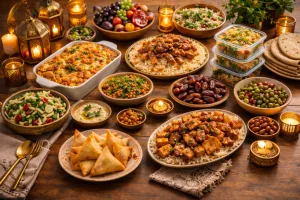
Menu architecture: breaking fast, starters, mains, sides, desserts, beverages
The easiest way to plan an iftar menu for guests is to think in layers, not random dishes.
A simple menu architecture looks like this:
- Break-fast essentials
- dates
- water
- optional milk / juice / tea setup
- Light opener (optional but helpful)
- soup
- salad
- a small starter
- Main meal
- one main protein or centerpiece dish
- one carb (rice, bread, pasta, grains)
- one or two sides
- Dessert / fruit
- make-ahead dessert works best
- fruit platter is an easy add-on
- Beverages
- water is non-negotiable
- tea/chai often expected
- one extra “special” nonalcoholic drink makes it feel festive
This structure helps you avoid the most common problem in Ramadan iftar hosting: lots of dishes with no flow.
The minimum viable iftar menu for low-stress hosting
If you’re hosting for the first time (or just want a calmer evening), here’s a strong minimum viable iftar:
- Dates + water setup
- One soup or salad
- One main dish
- One carb
- One side (preferably no-cook or make-ahead)
- One dessert (or fruit + tea)
- Tea/chai + water + one extra drink
That’s enough.
Hospitality during Ramadan is not measured by the number of pots on the stove. A simple, thoughtful meal served on time feels more generous than an elaborate menu served in chaos.
Make-ahead and freezer-friendly choices that save your energy
The best iftar prep tips are always make-ahead focused.
Good make-ahead choices for a home iftar:
- soups and stews
- marinated proteins
- sauces and dressings
- grain salads
- dips / mezze
- desserts that improve after chilling
- freezer-friendly pastries/snacks (if part of your routine)
What to avoid on hosting day (unless you’re very confident):
- multiple last-minute fried items
- dishes that require constant stove attention
- complicated plating
- “I’m trying this recipe for the first time” dishes
Experienced hosts and iftar-specific guides repeatedly stress prep-ahead and low-stress dishes for a reason: timing at sunset leaves less room for rescue.
Cooking while fasting: seasoning and no-taste strategies
One of the most practical — and least discussed — realities of hosting while fasting is this: you may not be tasting the food.
This is where systems beat instinct.
Use these strategies:
- Choose recipes you know well.
- Use measured seasoning instead of “season to taste.”
- Prep spice blends ahead of time.
- Keep finishing condiments on the table:
- salt
- lemon wedges
- chili flakes/chiles
- yogurt sauces
- Avoid highly improvisational dishes on hosting day.
This exact challenge is called out by experienced Ramadan hosts, and it’s a major reason simple, familiar menus work best.
Kitchen Tips That Actually Reduce Stress on Hosting Day
This is the heart of the article — because hosting iftar at home: kitchen tips is really about kitchen flow, not just cooking.
Create 3 kitchen zones: prep, drinks, and serving
A lot of iftar stress comes from using the same space for everything.
Create three clear zones, even in a small kitchen:
1) Prep station
What goes here:
- cutting board
- knife
- mixing bowl
- paper towels / cloth
- commonly used utensils
- seasonings used for final touches
Purpose:
- keeps your main prep tasks contained
- reduces walking back and forth
2) Beverage station
What goes here:
- water jug/bottles
- cups/glasses
- tea/chai setup
- juice/mocktail pitchers
- tray, napkins, stirrers/spoons
Purpose:
- hydration is easier
- guests (or a helper) can manage drinks without interfering with cooking
- takes pressure off the main counter
Separate drink stations are repeatedly mentioned in newer iftar hosting advice because they solve both hospitality and kitchen traffic problems.
3) Serving/plating zone
What goes here:
- serving platters
- serving spoons
- ladles
- garnish bowls
- towels/trivet
- one clear surface for final plating
Purpose:
- prevents “Where is the serving spoon?” chaos
- creates a clean landing zone for finished dishes
- protects your final 20 minutes before iftar
Protect your stove space and avoid last-minute bottlenecks
Stove space is one of the biggest hidden bottlenecks when hosting iftar for a crowd at home.
A practical rule:
- If everything needs the stove at the same time, your menu is too ambitious.
Use these strategies:
- Include no-cook sides (salads, dips, cold mezze).
- Reheat in stages (not all at once).
- Use oven + stovetop intentionally (don’t default to one).
- Keep one burner free if possible for emergencies.
- Choose one “hero” hot dish, not three.
This is one of the most useful real-world hosting insights in the Bon Appétit piece: sides matter, but they don’t all need stove space.

Counter management: what stays out and what gets cleared
A welcoming kitchen is not a crowded one.
Keep only what supports the iftar flow visible:
Should stay out
- dates (displayed and easy to reach)
- small bowl for date pits
- water and cups
- serving utensils for each dish
- napkins
- one platter/board for final assembly
Should be cleared or hidden
- unused gadgets
- grocery bags
- duplicate utensils
- nonessential decor on worktops
- dirty prep clutter (move to sink/hidden dish zone)
The “dates + pit bowl” detail is tiny, but it dramatically improves guest comfort in the first minutes of iftar. It’s one of those high-leverage hospitality touches that makes your setup feel thoughtful.
Clean-as-you-go and dishwashing strategy
You don’t need a spotless kitchen while hosting. You need a controlled mess.
Use a simple dishwashing strategy:
- designate one side of the sink for soaking,
- stack by category (pots / utensils / serveware),
- rinse high-priority items as soon as they’re empty,
- load dishwasher in one or two planned waves (if you have one),
- keep a “hidden dirty dish zone” so the kitchen still feels calm.
Why this matters:
- it protects your post-iftar energy,
- prevents cleanup dread,
- keeps counters usable for dessert/tea service.
A good Ramadan hosting kitchen organization system includes cleanup planning — not as an afterthought, but as part of the event design.
Your Iftar Hosting Timeline: Day Before to Serving Time
A timeline is the difference between “I’m hosting” and “I’m firefighting.”
24 hours before: prep what creates the biggest relief
Focus on tasks that remove pressure from hosting day:
- Finalize guest count and menu
- Shop and organize ingredients by recipe
- Marinate proteins
- Make sauces, dressings, dips
- Prep dessert (or at least dessert components)
- Chill drinks
- Pull out serving platters and utensils
- Check you have enough cups, bowls, napkins
- Set up prayer-space basics (if relevant in your home)
- Plan seating for children / elderly guests
This is also the best time to solve problems quietly (missing ingredient, extra chairs, broken serving spoon, etc.).
Morning / early afternoon: start with long-cook items
Start with anything that benefits from resting or reheating:
- soups, stews, braises
- rice prep plan (if using)
- baking items
- tea/chai base prep (if you batch it)
- salad ingredient washing/chopping (store separately)
- station setup (prep / drinks / serving)
By early afternoon, your goal is not “finish cooking.” Your goal is to get your kitchen into a state where the final stretch is manageable.
90–30 minutes before iftar: final setup, reheating, and table flow
This window is where most hosting stress happens — so don’t overload it.
What should happen here:
- Set out dates, pit bowl, water, cups
- Finish or reheat mains in sequence
- Plate no-cook sides and salads
- Assign drinks to one station
- Put serving spoons in each platter
- Clear one plating/landing surface
- Quick counter wipe
- Final check: napkins, glasses, chairs, prayer flow
What should not happen here (if avoidable):
- starting a brand-new dish,
- searching for serving ware,
- deep cleaning,
- complicated garnishing.
15 minutes before iftar: switch to host mode, not cooking mode
This is your line in the sand.
At this point:
- stop adding complexity,
- accept “done enough,”
- take a breath,
- welcome guests,
- guide the break-fast setup calmly.
A strong home iftar feels calm because the host is present — not because every dish is perfect.
Set the Table and Atmosphere Without Overcomplicating the Kitchen
Break-fast essentials setup: dates, water, tea, and small bowls
The first minutes of iftar deserve special attention.
Create a break-fast setup that is visible and easy:
- dates on a plate or tray
- small bowl for pits
- water (individual glasses or a pour-your-own setup)
- napkins
- optional milk / juice
- tea/chai either ready or clearly in progress
This setup reduces awkwardness and makes guests feel cared for immediately — especially if some are joining your home iftar for the first time.
Warm lighting and simple Ramadan decor that won’t create clutter
You do not need a full decor production to host a beautiful iftar at home.
A few high-impact touches are enough:
- warm lighting (lamps, fairy lights, lanterns)
- one simple centerpiece
- coordinated napkins or tableware
- a tray-based display for dates and drinks
- candles/lanterns in safe locations (away from active prep areas)
Keep decor away from your main kitchen workflow. A cluttered kitchen can look festive in photos but feel stressful in real use.

The best Ramadan hosting setups are warm because they’re intentional, not overloaded.
Prayer space and comfort touches for guests
If your guests will pray at your home, a few thoughtful preparations make a big difference:
- a quiet corner,
- prayer mats ready,
- enough space to move comfortably,
- a place for shoes/bags that doesn’t block walkways.
Also consider comfort beyond prayer:
- easy seating for elderly guests,
- a simple kids-friendly area or task (coloring/table setting/helping with drinks),
- clear access to water and restrooms.
This is what turns iftar entertaining at home into real hospitality.
Hosting Etiquette: How to Make Guests Feel Truly Welcome
Communicate the menu and set expectations
One of the most underrated iftar hosting tips: tell people what they’re eating.
Why it helps:
- guests know what to expect,
- dietary restrictions are easier to manage,
- contributors (if potluck-style) avoid duplication,
- and you reduce your own stress.
A simple message works:
“We’ll break fast with dates/water, then soup + a main + sides + dessert/tea. If you’d like to bring something, drinks/fruit are always helpful.”
This is also a practical anti-chaos move, not just etiquette. Bon Appétit highlights this exact point as part of panic-proof hosting.
Keep the evening inclusive and relaxed
A good host creates flow, not pressure.
Ways to keep your home iftar inclusive:
- don’t force a rigid sequence if your group is mixed,
- let guests know where drinks and dates are,
- gently guide anyone unfamiliar with the flow,
- avoid disappearing into the kitchen for long stretches,
- ask for small help if offered (pour drinks, carry platters, clear cups).
People remember how an evening felt more than they remember how many sides you served.
Leftovers, take-home containers, and generosity without waste
Generosity and practicality can coexist.
If you expect extra food:
- have containers ready,
- portion leftovers quickly after the meal,
- offer take-home packs intentionally,
- refrigerate what needs saving before tea/dessert stretches too long.
This helps with:
- food waste reduction,
- next-day kitchen cleanup,
- and that feeling of “we cooked too much and now it’s all a mess.”
A little planning here makes your hosting feel abundant, not excessive.
Common Home Iftar Hosting Mistakes and How to Avoid Them
1) Cooking too many dishes
Why it happens:
Hospitality pressure + social media expectations + “What if it’s not enough?”
Fix:
Use menu architecture and choose:
- 1 hero main
- 1 carb
- 1–2 sides
- 1 dessert / fruit
- strong drinks setup
Abundance comes from thoughtful flow, not dish count.
2) Leaving everything for the last hour
Why it happens:
Underestimating setup time (serving ware, drinks, table, reheating).
Fix:
Use the timeline above and move anything possible to the day before:
- sauces
- marinating
- dessert
- tableware
- station setup
- drink chilling
3) Overloading the stove and underplanning drinks
Why it happens:
We tend to focus on mains and forget hydration and beverage flow.
Fix:
Protect stove space with no-cook sides and build a separate beverage station. This is one of the easiest upgrades to your Ramadan hosting kitchen organization.
4) Ignoring serving tools, seating, or prayer flow
Why it happens:
These details feel “small” — until they create friction.
Fix:
Do a final walkthrough:
- Is every dish paired with a serving spoon?
- Are dates and water visible?
- Is there a bowl for pits?
- Is there enough seating?
- Is movement to prayer space clear?
5) Chasing perfection instead of comfort and connection
Why it happens:
Hosting can become performance.
Fix:
Choose a clear intention:
- on-time break-fast,
- calm kitchen,
- warm atmosphere,
- present host.
That’s a successful iftar.
A Practical Iftar Hosting Checklist (Printable-Friendly)
1 week before
- Decide guest list and send invitations / request RSVPs
- Ask about allergies and dietary restrictions
- Choose hosting format (intimate / medium / crowd)
- Decide buffet vs table service
- Build your iftar menu architecture
- Make shopping list by category
- Confirm what can be made ahead or frozen
1–2 days before
- Shop and organize ingredients by recipe
- Marinate proteins / prep sauces / make dips
- Prepare dessert (or dessert components)
- Chill beverages
- Pull out tableware, serving platters, serving spoons
- Set up prayer corner basics (if needed)
- Plan seating and guest flow
- Create kitchen zones: prep / drinks / serving
Hosting day
- Start long-cook dishes first
- Prep and plate no-cook sides/salads
- Set break-fast essentials (dates, pit bowl, water, cups, napkins)
- Reheat in stages (don’t overload stove space)
- Keep one counter clear for final plating
- Use clean-as-you-go dish strategy
- Switch to host mode 15 minutes before iftar
After iftar
- Pack leftovers promptly
- Offer take-home containers
- Quick reset key surfaces
- Soak priority pots
- Make a note of what worked (menu, timing, quantities) for next time
Final Thoughts: A Memorable Iftar Starts With a Calm Kitchen
The most memorable iftars at home are not always the most elaborate.
They’re the ones where:
- people can break their fast comfortably,
- the host isn’t overwhelmed,
- the kitchen supports the evening instead of fighting it,
- and the atmosphere feels warm, generous, and grounded in the spirit of Ramadan.
If you focus on planning, kitchen flow, and thoughtful hospitality, you’ll not only host a better iftar — you’ll enjoy it more too.
And that’s the real goal of great iftar hosting at home.